We're not just about the big transformations; small projects receive the same level of care and professionalism. They understand that electrical problems don't stick to a 9-to-5 schedule, which is why they provide emergency services beyond standard operating hours. Their team of professionals doesn't just meet the standard; they redefine it, offering expertise in everything from minor electrical repairs to comprehensive installation services and beyond. Additionally, for those embracing renewable energy, Star Victory Electric LLC can install solar panels, helping you to reduce your carbon footprint and save on energy bills. Learn more about Business electrical inspections Northbrook here They ensure your entire electrical system is up to the challenge, upgrading wiring and panels to handle these new technologies safely.
Understanding the importance of your peace of mind, we also offer comprehensive emergency electrical support services to address urgent issues swiftly. Learn more about Northbrook’s Trusted Commercial Electrical Experts here. With a deep commitment to keeping you and your family secure, they go the extra mile to ensure that all electrical installations and repairs meet the highest industry standards. They conduct a thorough analysis to identify underlying issues that could cause future failures or safety hazards. They're not just about wires and circuits; they're about people.
You're not just hiring electricians; you're partnering with a team that values your trust and works tirelessly to maintain it. Overloaded circuits, outdated wiring, and faulty electrical appliances can pose serious risks. Electric Outlet Their commitment to excellence and the community's well-being quickly set them apart. While professional certifications showcase the expertise of Star Victory Electric LLC's team, their commitment to customer service excellence truly sets them apart.
Each electrician at Star Victory Electric has undergone rigorous training and assessments to achieve their certifications. In short, Star Victory Electric LLC is your go-to for all your electrical needs in Northbrook. Choosing Star Victory Electric, a licensed and insured electrician, gives you peace of mind knowing that you're fully protected. Moreover, their support extends beyond just maintenance.
You'll be pleased to know that Star Victory Electric LLC is now extending its reliable and trusted residential electrical services across Business electrical inspections Northbrook, ensuring that your electrical needs are promptly addressed before they escalate into bigger issues. Whichever method you choose, Star Victory Electric makes it easy to connect and ensures your home's electrical safety is in good hands. You'll find that homeowners across Northbrook can't stop praising the professionalism, expertise, and reliability that Star Victory Electric brings to the table. This step ensures we're fully prepared to meet your needs on the day of service.
It's all about providing you with peace of mind, knowing your home is as safe as it's efficient. Understanding that electrical emergencies can happen at any time, Star Victory Electric offers round-the-clock emergency services to keep your home safe and powered. Work (electric field) Back then, you'd have found a small, dedicated team working out of a modest workshop, committed to providing the best electrical services in town.
Their team stays ahead of the curve, bringing you innovations like energy-saving LED lighting systems, automated home systems, and smart appliances that can significantly reduce your energy bills.
What happens when you face an electrical emergency in your home? They were behind the comprehensive wiring of the Northbrook Community Library, integrating state-of-the-art electrical systems that not only made it a beacon of sustainability but also a model for future public buildings.

But it's not just about swapping out light bulbs or updating appliances. Let them illuminate your home in ways you've never imagined. Their promise to you is simple: they won't consider the job done until you're 100% satisfied. Whether it's a simple wiring fix or a complex installation, they follow a set of strict safety procedures to mitigate any risks.
We understand that you're not just looking for electrical services; you're seeking a partner you can trust to keep your home safe and functional. Their dedication to quality doesn't stop at their credentials. Whether it's outdated wiring that needs an upgrade or a circuit breaker that requires replacement, Star Victory Electric's experts have got you covered.
This means you won't have to endure lengthy downtimes or put your safety at risk while waiting for a solution. You'll find that Star Victory Electric doesn't just stop at basic electrical tasks. This not only enhances your safety but also reduces the inconvenience of manually checking and resetting breakers after an outage or surge.
You're looking for solutions that address the root cause and ensure your electrical system is safe, efficient, and reliable for years to come. If you're more comfortable making arrangements over the phone, we've got you covered. electrical wiring While Star Victory Electric's projects showcase their technical prowess, it's their unparalleled customer service that truly sets them apart.
This milestone wasn't just a nod to the future of energy-it was a clear statement of their dedication to sustainability and innovation. We're here to keep your home safe, efficient, and up to code, so you can rest easy knowing your electrical needs are in the best hands. Whether you're planning a major renovation, need minor repairs, or are looking to upgrade your home's electrical system, they've got you covered. With Star Victory Electric, you're not just updating your home; you're future-proofing it. This ensures you're within their reach before you even pick up the phone.
Whether it's a sleek, modern kitchen lighting project or a complex home automation system, we pride ourselves on delivering both functionality and aesthetics. They understand the importance of trust in such critical services, ensuring you're never in the dark about the costs involved. As new advancements emerge, your home will be ready to integrate them, keeping you on the cutting edge of home automation and efficiency. They've gone beyond simply installing and repairing electrical systems, making it their mission to forge strong bonds within the area they serve.
Their clear communication and transparent pricing mean there are no surprises, just high-quality service tailored to meet your specific needs. Over the years, Star Victory Electric has hit numerous milestones, showcasing their commitment to excellence and innovation in the electrical services sector. Electrician (disambiguation) Don't overlook the importance of using qualified professionals like Star Victory Electric for these tasks. You'll find comfort in knowing that help is available 24/7.
They'll also test your electrical panel and outlets to ensure they're functioning correctly and safely. What's more, they're known for their promptness and reliability. They're not just any team; they're the specialists you turn to when you want the job done right the first time. Our goal is to make our top-notch electrical services more accessible to you.
You might be surprised to find out how much energy older systems waste. Stick with us as we unveil the layers that make Star Victory Electric stand out in the crowded field of electrical services. Star Victory Electric LLC also supports local emergency services by providing them with essential electrical safety training, ensuring they're prepared to handle electrical emergencies safely and efficiently. So, for all your electrical needs, big or small, trust Star Victory Electric LLC to light up your home. You'll find that they're not just about aesthetics; they also focus on practical solutions that improve your home's efficiency and safety.
With Star Victory Electric LLC, you're not just another job. They're not just working on your electrical system; they're building a relationship based on trust and satisfaction. Whether you're in need of routine maintenance, a comprehensive home electrical inspection, or emergency services, getting in touch is straightforward.
From the initial consultation to the final inspection, they'll keep you in the loop, ensuring that your project stays on track and within budget. At the heart of Northbrook's residential electrician services lies an unmatched commitment to quality, ensuring your home's electrical needs are met with unparalleled expertise and precision. You're now able to control your home's lighting, security, and temperature with the touch of a button, thanks to our certified technicians who specialize in the latest smart home technologies. Choosing us means you're partnering with a company that values safety, quality, and customer satisfaction above all else. You wouldn't skip your oil change or ignore a check engine light, right?
They're ahead of the curve, integrating the latest electrical systems and smart home technologies into their offerings.
 |
The examples and perspective in this article deal primarily with the English-speaking world and do not represent a worldwide view of the subject. (March 2025)
|

|
|
| Occupation | |
|---|---|
|
Occupation type
|
Vocational |
|
Activity sectors
|
Maintenance, Electrical Grid |
| Description | |
|
Education required
|
Apprenticeship |
|
Fields of
employment |
Construction |
|
Related jobs
|
Lineperson |
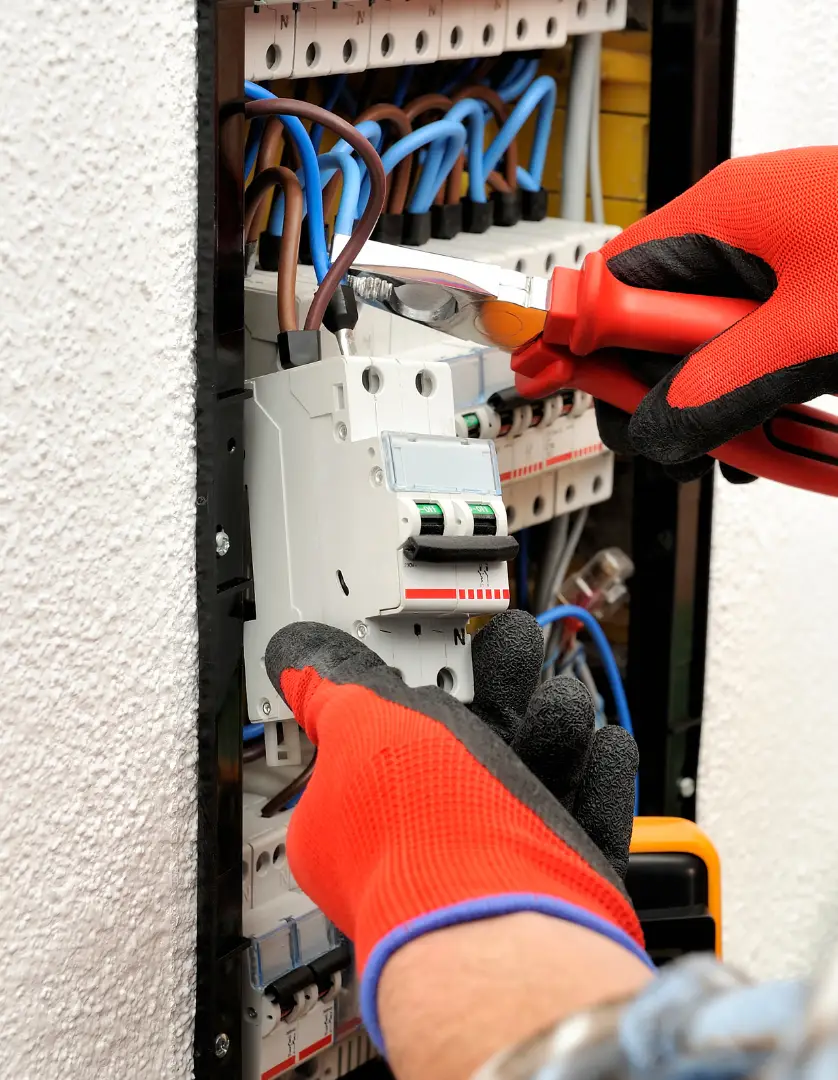
An electrician is a tradesperson specializing in electrical wiring of buildings, transmission lines, stationary machines, and related equipment. Electricians may be employed in the installation of new electrical components or the maintenance and repair of existing electrical infrastructure.[1] Electricians may also specialize in wiring ships, airplanes, and other mobile platforms, as well as data and cable lines.
Electricians were originally people who demonstrated or studied the principles of electricity, often electrostatic generators of one form or another.[2]
In the United States, electricians are divided into two primary categories: lineperson, who work on electric utility company distribution systems at higher voltages, and wiremen, who work with the lower voltages utilized inside buildings. Wiremen are generally trained in one of five primary specialties: commercial, residential, light industrial, industrial, and low-voltage wiring, more commonly known as Voice-Data-Video, or VDV. Other sub-specialties such as control wiring and fire-alarm may be performed by specialists trained in the devices being installed, or by inside wiremen.
Electricians are trained to one of three levels: Apprentice, Journeyperson, and Master Electrician. In the US and Canada, apprentices work and receive a reduced compensation while learning their trade. They generally take several hundred hours of classroom instruction and are contracted to follow apprenticeship standards for a period of between three and six years, during which time they are paid as a percentage of the Journeyperson's pay. Journeymen are electricians who have completed their Apprenticeship and who have been found by the local, State, or National licensing body to be competent in the electrical trade. Master Electricians have performed well in the trade for a period of time, often seven to ten years, and have passed an exam to demonstrate superior knowledge of the National Electrical Code, or NEC.
Service electricians are tasked to respond to requests for isolated repairs and upgrades. They have skills troubleshooting wiring problems, installing wiring in existing buildings, and making repairs. Construction electricians primarily focus on larger projects, such as installing all new electrical system for an entire building, or upgrading an entire floor of an office building as part of a remodeling process. Other specialty areas are marine electricians, research electricians and hospital electricians. "Electrician" is also used as the name of a role in stagecraft, where electricians are tasked primarily with hanging, focusing, and operating stage lighting. In this context, the Master Electrician is the show's chief electrician. Although theater electricians routinely perform electrical work on stage lighting instruments and equipment, they are not part of the electrical trade and have a different set of skills and qualifications from the electricians that work on building wiring.
In the film industry and on a television crew the head electrician is referred to as a Gaffer.
Electrical contractors are businesses that employ electricians to design, install, and maintain electrical systems. Contractors are responsible for generating bids for new jobs, hiring tradespeople for the job, providing material to electricians in a timely manner, and communicating with architects, electrical and building engineers, and the customer to plan and complete the finished product.


Many jurisdictions have regulatory restrictions concerning electrical work for safety reasons due to the many hazards of working with electricity. Such requirements may be testing, registration or licensing. Licensing requirements vary between jurisdictions.
An electrician's license entitles the holder to carry out all types of electrical installation work in Australia without supervision. However, to contract, or offer to contract, to carry out electrical installation work, a licensed electrician must also be registered as an electrical contractor. Under Australian law, electrical work that involves fixed wiring is strictly regulated and must almost always be performed by a licensed electrician or electrical contractor.[3] A local electrician can handle a range of work including air conditioning, light fittings and installation, safety switches, smoke alarm installation, inspection and certification and testing and tagging of electrical appliances.
To provide data, structured cabling systems, home automation & theatre, LAN, WAN and VPN data solutions or phone points, an installer must be licensed as a Telecommunications Cable Provider under a scheme controlled by Australian Communications and Media Authority[4]
Electrical licensing in Australia is regulated by the individual states. In Western Australia, the Department of Commerce tracks licensee's and allows the public to search for individually named/licensed Electricians.[5]
Currently in Victoria the apprenticeship lasts for four years, during three of those years the apprentice attends trade school in either a block release of one week each month or one day each week. At the end of the apprenticeship the apprentice is required to pass three examinations, one of which is theory based with the other two practically based. Upon successful completion of these exams, providing all other components of the apprenticeship are satisfactory, the apprentice is granted an A Class licence on application to Energy Safe Victoria (ESV).
An A Class electrician may perform work unsupervised but is unable to work for profit or gain without having the further qualifications necessary to become a Registered Electrical Contractor (REC) or being in the employment of a person holding REC status. However, some exemptions do exist.[6]
In most cases a certificate of electrical safety must be submitted to the relevant body after any electrical works are performed.
Safety equipment used and worn by electricians in Australia (including insulated rubber gloves and mats) needs to be tested regularly to ensure it is still protecting the worker. Because of the high risk involved in this trade, this testing needs to be performed regularly and regulations vary according to state. Industry best practice is the Queensland Electrical Safety Act 2002, and requires six-monthly testing.

Training of electricians follows an apprenticeship model, taking four or five years to progress to fully qualified journeyperson level.[7] Typical apprenticeship programs consists of 80-90% hands-on work under the supervision of journeymen and 10-20% classroom training.[8] Training and licensing of electricians is regulated by each province, however professional licenses are valid throughout Canada under Agreement on Internal Trade. An endorsement under the Red Seal Program provides additional competency assurance to industry standards.[9] In order for individuals to become a licensed electricians, they need to have 9000 hours of practical, on the job training. They also need to attend school for 4 terms and pass a provincial exam. This training enables them to become journeyperson electricians. Furthermore, in British Columbia, an individual can go a step beyond that and become a "FSR", or field safety representative. This credential gives the ability to become a licensed electrical contractor and to pull permits. Notwithstanding this, some Canadian provinces only grant "permit pulling privileges" to current Master Electricians, that is, a journeyperson who has been engaged in the industry for three years and has passed the Master's examination (i.e. Alberta). The various levels of field safety representatives are A, B and C. The only difference between each class is that they are able to do increasingly higher voltage and current work.
The two qualification awarding organisations are City and Guilds and EAL. Electrical competence is required at Level 3 to practice as a 'qualified electrician' in the UK. Once qualified and demonstrating the required level of competence an Electrician can apply to register for a Joint Industry Board Electrotechnical Certification Scheme card in order to work on building sites or other controlled areas.
Although partly covered during Level 3 training, more in depth knowledge and qualifications can be obtained covering subjects such as Design and Verification or Testing and Inspection among others. These additional qualifications can be listed on the reverse of the JIB card. Beyond this level is additional training and qualifications such as EV charger installations or training and working in specialist areas such as street furniture or within industry.
The Electricity at Work Regulations are a statutory document that covers the use and proper maintenance of electrical equipment and installations within businesses and other organisations such as charities. Parts of the Building Regulations cover the legal requirements of the installation of electrical technical equipment with Part P outlining most of the regulations covering dwellings
Information regarding design, selection, installation and testing of electrical structures is provided in the non-statutory publication 'Requirements for Electrical Installations, IET Wiring Regulations, Eighteenth Edition, BS 7671:2018' otherwise known as the Wiring Regulations or 'Regs'. Usual amendments are published on an ad hoc bases when minor changes occur. The first major update of the 18th Edition were published during February 2020 mainly covering the section covering Electric vehicles charger installations although an addendum was published during December 2019 correcting some minor mistakes and adding some small changes. The IET also publish a series of 'Guidance Notes' in book form that provide further in-depth knowledge.
With the exception of the work covered by Part P of the Building Regulations, such as installing consumer units, new circuits or work in bathrooms, there are no laws that prevent anyone from carrying out some basic electrical work in the UK.
In British English, an electrician is colloquially known as a "spark".[10]

The United States does not offer nationwide licensing and electrical licenses are issued by individual states. There are variations in licensing requirements, however, all states recognize three basic skill categories: level electricians. Journeyperson electricians can work unsupervised provided that they work according to a master's direction. Generally, states do not offer journeyperson permits, and journeyperson electricians and other apprentices can only work under permits issued to a master electrician. Apprentices may not work without direct supervision.[11]
Before electricians can work unsupervised, they are usually required to serve an apprenticeship lasting three to five years under the general supervision of a master electrician and usually the direct supervision of a journeyperson electrician.[11] Schooling in electrical theory and electrical building codes is required to complete the apprenticeship program. Many apprenticeship programs provide a salary to the apprentice during training. A journeyperson electrician is a classification of licensing granted to those who have met the experience requirements for on the job training (usually 4,000 to 6,000 hours) and classroom hours (about 144 hours). Requirements include completion of two to six years of apprenticeship training and passing a licensing exam.[12]
An electrician's license is valid for work in the state where the license was issued. In addition, many states recognize licenses from other states, sometimes called interstate reciprocity participation, although there can be conditions imposed. For example, California reciprocates with Arizona, Nevada, and Utah on the condition that licenses are in good standing and have been held at the other state for five years.[13] Nevada reciprocates with Arizona, California, and Utah.[14] Maine reciprocates with New Hampshire and Vermont at the master level, and the state reciprocates with New Hampshire, North Dakota, Idaho, Oregon, Vermont, and Wyoming at the journeyperson level.[15] Colorado maintains a journeyperson alliance with Alaska, Arkansas, the Dakotas, Idaho, Iowa, Minnesota, Montana, Nebraska, New Hampshire, New Mexico, Oklahoma, Utah, and Wyoming.[16]
Electricians use a range of hand and power tools and instruments.

Some of the more common tools are:
In addition to the workplace hazards generally faced by industrial workers, electricians are also particularly exposed to injury by electricity. An electrician may experience electric shock due to direct contact with energized circuit conductors or due to stray voltage caused by faults in a system. An electric arc exposes eyes and skin to hazardous amounts of heat and light. Faulty switchgear may cause an arc flash incident with a resultant blast. Electricians are trained to work safely and take many measures to minimize the danger of injury. Lockout and tagout procedures are used to make sure that circuits are proven to be de-energized before work is done. Limits of approach to energized equipment protect against arc flash exposure; specially designed flash-resistant clothing provides additional protection; grounding (earthing) clamps and chains are used on line conductors to provide a visible assurance that a conductor is de-energized. Personal protective equipment provides electrical insulation as well as protection from mechanical impact; gloves have insulating rubber liners, and work boots and hard hats are specially rated to provide protection from shock. If a system cannot be de-energized, insulated tools are used; even high-voltage transmission lines can be repaired while energized, when necessary.[17]
Electrical workers, which includes electricians, accounted for 34% of total electrocutions of construction trades workers in the United States between 1992 and 2003.[18]

Working conditions for electricians vary by specialization. Generally an electrician's work is physically demanding such as climbing ladders and lifting tools and supplies. Occasionally an electrician must work in a cramped space or on scaffolding, and may frequently be bending, squatting or kneeling, to make connections in awkward locations. Construction electricians may spend much of their days in outdoor or semi-outdoor loud and dirty work sites. Industrial electricians may be exposed to the heat, dust, and noise of an industrial plant. Power systems electricians may be called to work in all kinds of adverse weather to make emergency repairs.
Some electricians are union members and work under their union's policies.
Electricians can choose to be represented by the Electrical Trade Union (ETU). Electrical Contractors can be represented by the National Electrical & Communications Association or Master Electricians Australia.
Some electricians are union members. Some examples of electricians' unions include the International Brotherhood of Electrical Workers, Canadian Union of Public Employees, and the International Association of Machinists and Aerospace Workers.
The International Brotherhood of Electrical Workers provides its own apprenticeships through its National Joint Apprenticeship and Training Committee and the National Electrical Contractors Association. Many merit shop training and apprenticeship programs also exist, including those offered by such as trade associations as Associated Builders and Contractors and Independent Electrical Contractors. These organizations provide comprehensive training, in accordance with U.S. Department of Labor regulations.
In the United Kingdom, electricians are represented by several unions including Unite the Union
In the Republic of Ireland there are two self-regulation/self certification bodies RECI Register of Electrical Contractors of Ireland and ECSSA.
An auto electrician is a tradesperson specializing in electrical wiring of motor vehicles. Auto electricians may be employed in the installation of new electrical components or the maintenance and repair of existing electrical components. Auto electricians specialize in cars and commercial vehicles. The auto electrical trade is generally more difficult than the electrical trade due to the confined spaces, engineering complexity of modern automotive electrical systems, and working conditions (often roadside breakdowns or on construction sites, mines, quarries to repair machinery etc.) Also the presence of high-current DC electricity makes injury from burns and arc-flash injury possible.

|
|
The examples and perspective in this article deal primarily with the English-speaking world and do not represent a worldwide view of the subject. (March 2025)
|
|
|
|
| Occupation | |
|---|---|
|
Occupation type
|
Vocational |
|
Activity sectors
|
Maintenance, Electrical Grid |
| Description | |
|
Education required
|
Apprenticeship |
|
Fields of
employment |
Construction |
|
Related jobs
|
Lineperson |
An electrician is a tradesperson specializing in electrical wiring of buildings, transmission lines, stationary machines, and related equipment. Electricians may be employed in the installation of new electrical components or the maintenance and repair of existing electrical infrastructure.[1] Electricians may also specialize in wiring ships, airplanes, and other mobile platforms, as well as data and cable lines.
Electricians were originally people who demonstrated or studied the principles of electricity, often electrostatic generators of one form or another.[2]
In the United States, electricians are divided into two primary categories: lineperson, who work on electric utility company distribution systems at higher voltages, and wiremen, who work with the lower voltages utilized inside buildings. Wiremen are generally trained in one of five primary specialties: commercial, residential, light industrial, industrial, and low-voltage wiring, more commonly known as Voice-Data-Video, or VDV. Other sub-specialties such as control wiring and fire-alarm may be performed by specialists trained in the devices being installed, or by inside wiremen.
Electricians are trained to one of three levels: Apprentice, Journeyperson, and Master Electrician. In the US and Canada, apprentices work and receive a reduced compensation while learning their trade. They generally take several hundred hours of classroom instruction and are contracted to follow apprenticeship standards for a period of between three and six years, during which time they are paid as a percentage of the Journeyperson's pay. Journeymen are electricians who have completed their Apprenticeship and who have been found by the local, State, or National licensing body to be competent in the electrical trade. Master Electricians have performed well in the trade for a period of time, often seven to ten years, and have passed an exam to demonstrate superior knowledge of the National Electrical Code, or NEC.
Service electricians are tasked to respond to requests for isolated repairs and upgrades. They have skills troubleshooting wiring problems, installing wiring in existing buildings, and making repairs. Construction electricians primarily focus on larger projects, such as installing all new electrical system for an entire building, or upgrading an entire floor of an office building as part of a remodeling process. Other specialty areas are marine electricians, research electricians and hospital electricians. "Electrician" is also used as the name of a role in stagecraft, where electricians are tasked primarily with hanging, focusing, and operating stage lighting. In this context, the Master Electrician is the show's chief electrician. Although theater electricians routinely perform electrical work on stage lighting instruments and equipment, they are not part of the electrical trade and have a different set of skills and qualifications from the electricians that work on building wiring.
In the film industry and on a television crew the head electrician is referred to as a Gaffer.
Electrical contractors are businesses that employ electricians to design, install, and maintain electrical systems. Contractors are responsible for generating bids for new jobs, hiring tradespeople for the job, providing material to electricians in a timely manner, and communicating with architects, electrical and building engineers, and the customer to plan and complete the finished product.
Many jurisdictions have regulatory restrictions concerning electrical work for safety reasons due to the many hazards of working with electricity. Such requirements may be testing, registration or licensing. Licensing requirements vary between jurisdictions.
An electrician's license entitles the holder to carry out all types of electrical installation work in Australia without supervision. However, to contract, or offer to contract, to carry out electrical installation work, a licensed electrician must also be registered as an electrical contractor. Under Australian law, electrical work that involves fixed wiring is strictly regulated and must almost always be performed by a licensed electrician or electrical contractor.[3] A local electrician can handle a range of work including air conditioning, light fittings and installation, safety switches, smoke alarm installation, inspection and certification and testing and tagging of electrical appliances.
To provide data, structured cabling systems, home automation & theatre, LAN, WAN and VPN data solutions or phone points, an installer must be licensed as a Telecommunications Cable Provider under a scheme controlled by Australian Communications and Media Authority[4]
Electrical licensing in Australia is regulated by the individual states. In Western Australia, the Department of Commerce tracks licensee's and allows the public to search for individually named/licensed Electricians.[5]
Currently in Victoria the apprenticeship lasts for four years, during three of those years the apprentice attends trade school in either a block release of one week each month or one day each week. At the end of the apprenticeship the apprentice is required to pass three examinations, one of which is theory based with the other two practically based. Upon successful completion of these exams, providing all other components of the apprenticeship are satisfactory, the apprentice is granted an A Class licence on application to Energy Safe Victoria (ESV).
An A Class electrician may perform work unsupervised but is unable to work for profit or gain without having the further qualifications necessary to become a Registered Electrical Contractor (REC) or being in the employment of a person holding REC status. However, some exemptions do exist.[6]
In most cases a certificate of electrical safety must be submitted to the relevant body after any electrical works are performed.
Safety equipment used and worn by electricians in Australia (including insulated rubber gloves and mats) needs to be tested regularly to ensure it is still protecting the worker. Because of the high risk involved in this trade, this testing needs to be performed regularly and regulations vary according to state. Industry best practice is the Queensland Electrical Safety Act 2002, and requires six-monthly testing.
Training of electricians follows an apprenticeship model, taking four or five years to progress to fully qualified journeyperson level.[7] Typical apprenticeship programs consists of 80-90% hands-on work under the supervision of journeymen and 10-20% classroom training.[8] Training and licensing of electricians is regulated by each province, however professional licenses are valid throughout Canada under Agreement on Internal Trade. An endorsement under the Red Seal Program provides additional competency assurance to industry standards.[9] In order for individuals to become a licensed electricians, they need to have 9000 hours of practical, on the job training. They also need to attend school for 4 terms and pass a provincial exam. This training enables them to become journeyperson electricians. Furthermore, in British Columbia, an individual can go a step beyond that and become a "FSR", or field safety representative. This credential gives the ability to become a licensed electrical contractor and to pull permits. Notwithstanding this, some Canadian provinces only grant "permit pulling privileges" to current Master Electricians, that is, a journeyperson who has been engaged in the industry for three years and has passed the Master's examination (i.e. Alberta). The various levels of field safety representatives are A, B and C. The only difference between each class is that they are able to do increasingly higher voltage and current work.
The two qualification awarding organisations are City and Guilds and EAL. Electrical competence is required at Level 3 to practice as a 'qualified electrician' in the UK. Once qualified and demonstrating the required level of competence an Electrician can apply to register for a Joint Industry Board Electrotechnical Certification Scheme card in order to work on building sites or other controlled areas.
Although partly covered during Level 3 training, more in depth knowledge and qualifications can be obtained covering subjects such as Design and Verification or Testing and Inspection among others. These additional qualifications can be listed on the reverse of the JIB card. Beyond this level is additional training and qualifications such as EV charger installations or training and working in specialist areas such as street furniture or within industry.
The Electricity at Work Regulations are a statutory document that covers the use and proper maintenance of electrical equipment and installations within businesses and other organisations such as charities. Parts of the Building Regulations cover the legal requirements of the installation of electrical technical equipment with Part P outlining most of the regulations covering dwellings
Information regarding design, selection, installation and testing of electrical structures is provided in the non-statutory publication 'Requirements for Electrical Installations, IET Wiring Regulations, Eighteenth Edition, BS 7671:2018' otherwise known as the Wiring Regulations or 'Regs'. Usual amendments are published on an ad hoc bases when minor changes occur. The first major update of the 18th Edition were published during February 2020 mainly covering the section covering Electric vehicles charger installations although an addendum was published during December 2019 correcting some minor mistakes and adding some small changes. The IET also publish a series of 'Guidance Notes' in book form that provide further in-depth knowledge.
With the exception of the work covered by Part P of the Building Regulations, such as installing consumer units, new circuits or work in bathrooms, there are no laws that prevent anyone from carrying out some basic electrical work in the UK.
In British English, an electrician is colloquially known as a "spark".[10]
The United States does not offer nationwide licensing and electrical licenses are issued by individual states. There are variations in licensing requirements, however, all states recognize three basic skill categories: level electricians. Journeyperson electricians can work unsupervised provided that they work according to a master's direction. Generally, states do not offer journeyperson permits, and journeyperson electricians and other apprentices can only work under permits issued to a master electrician. Apprentices may not work without direct supervision.[11]
Before electricians can work unsupervised, they are usually required to serve an apprenticeship lasting three to five years under the general supervision of a master electrician and usually the direct supervision of a journeyperson electrician.[11] Schooling in electrical theory and electrical building codes is required to complete the apprenticeship program. Many apprenticeship programs provide a salary to the apprentice during training. A journeyperson electrician is a classification of licensing granted to those who have met the experience requirements for on the job training (usually 4,000 to 6,000 hours) and classroom hours (about 144 hours). Requirements include completion of two to six years of apprenticeship training and passing a licensing exam.[12]
An electrician's license is valid for work in the state where the license was issued. In addition, many states recognize licenses from other states, sometimes called interstate reciprocity participation, although there can be conditions imposed. For example, California reciprocates with Arizona, Nevada, and Utah on the condition that licenses are in good standing and have been held at the other state for five years.[13] Nevada reciprocates with Arizona, California, and Utah.[14] Maine reciprocates with New Hampshire and Vermont at the master level, and the state reciprocates with New Hampshire, North Dakota, Idaho, Oregon, Vermont, and Wyoming at the journeyperson level.[15] Colorado maintains a journeyperson alliance with Alaska, Arkansas, the Dakotas, Idaho, Iowa, Minnesota, Montana, Nebraska, New Hampshire, New Mexico, Oklahoma, Utah, and Wyoming.[16]
Electricians use a range of hand and power tools and instruments.
Some of the more common tools are:
In addition to the workplace hazards generally faced by industrial workers, electricians are also particularly exposed to injury by electricity. An electrician may experience electric shock due to direct contact with energized circuit conductors or due to stray voltage caused by faults in a system. An electric arc exposes eyes and skin to hazardous amounts of heat and light. Faulty switchgear may cause an arc flash incident with a resultant blast. Electricians are trained to work safely and take many measures to minimize the danger of injury. Lockout and tagout procedures are used to make sure that circuits are proven to be de-energized before work is done. Limits of approach to energized equipment protect against arc flash exposure; specially designed flash-resistant clothing provides additional protection; grounding (earthing) clamps and chains are used on line conductors to provide a visible assurance that a conductor is de-energized. Personal protective equipment provides electrical insulation as well as protection from mechanical impact; gloves have insulating rubber liners, and work boots and hard hats are specially rated to provide protection from shock. If a system cannot be de-energized, insulated tools are used; even high-voltage transmission lines can be repaired while energized, when necessary.[17]
Electrical workers, which includes electricians, accounted for 34% of total electrocutions of construction trades workers in the United States between 1992 and 2003.[18]
Working conditions for electricians vary by specialization. Generally an electrician's work is physically demanding such as climbing ladders and lifting tools and supplies. Occasionally an electrician must work in a cramped space or on scaffolding, and may frequently be bending, squatting or kneeling, to make connections in awkward locations. Construction electricians may spend much of their days in outdoor or semi-outdoor loud and dirty work sites. Industrial electricians may be exposed to the heat, dust, and noise of an industrial plant. Power systems electricians may be called to work in all kinds of adverse weather to make emergency repairs.
Some electricians are union members and work under their union's policies.
Electricians can choose to be represented by the Electrical Trade Union (ETU). Electrical Contractors can be represented by the National Electrical & Communications Association or Master Electricians Australia.
Some electricians are union members. Some examples of electricians' unions include the International Brotherhood of Electrical Workers, Canadian Union of Public Employees, and the International Association of Machinists and Aerospace Workers.
The International Brotherhood of Electrical Workers provides its own apprenticeships through its National Joint Apprenticeship and Training Committee and the National Electrical Contractors Association. Many merit shop training and apprenticeship programs also exist, including those offered by such as trade associations as Associated Builders and Contractors and Independent Electrical Contractors. These organizations provide comprehensive training, in accordance with U.S. Department of Labor regulations.
In the United Kingdom, electricians are represented by several unions including Unite the Union
In the Republic of Ireland there are two self-regulation/self certification bodies RECI Register of Electrical Contractors of Ireland and ECSSA.
An auto electrician is a tradesperson specializing in electrical wiring of motor vehicles. Auto electricians may be employed in the installation of new electrical components or the maintenance and repair of existing electrical components. Auto electricians specialize in cars and commercial vehicles. The auto electrical trade is generally more difficult than the electrical trade due to the confined spaces, engineering complexity of modern automotive electrical systems, and working conditions (often roadside breakdowns or on construction sites, mines, quarries to repair machinery etc.) Also the presence of high-current DC electricity makes injury from burns and arc-flash injury possible.
Yes, they can recommend and install various eco-friendly and energy-saving electrical solutions to help you reduce your environmental impact. These include LED lighting, energy-efficient appliances, and smart home systems to optimize your energy use.
Yes, Star Victory Electric LLC offers educational resources and workshops for homeowners. You'll learn basic electrical safety and maintenance, helping you manage minor issues and understand when it's crucial to call in the professionals.
Yes, Star Victory Electric LLC can definitely help you with your outdoor landscaping projects or exterior lighting designs. They've got the expertise to ensure everything's set up safely and efficiently, perfectly illuminating your space.


